
Osprey Porter 46 vs Osprey Farpoint 40: Pros & Cons

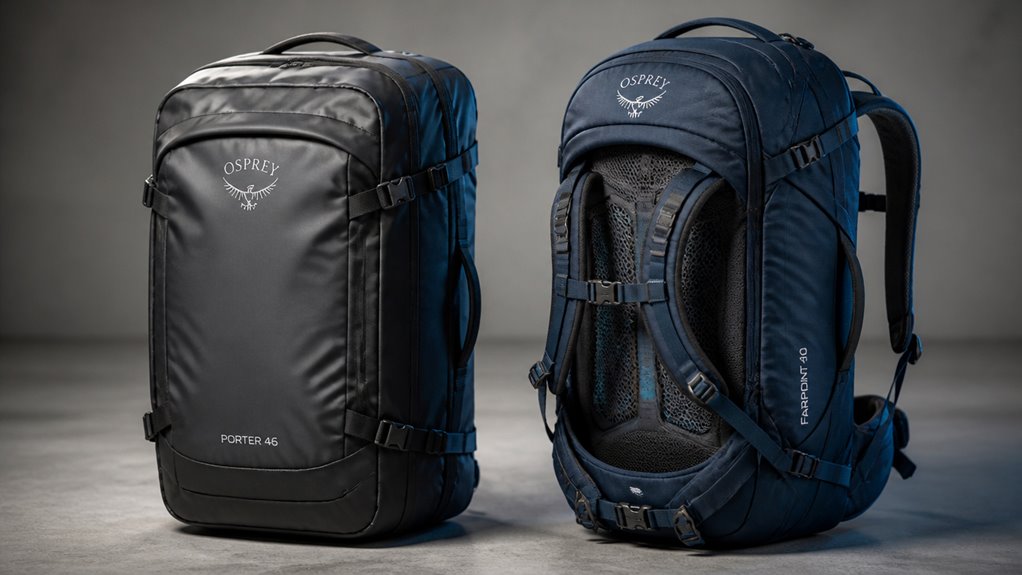
When choosing between the Osprey Porter 46 and Farpoint 40, consider your travel priorities.
The Porter 46 gives you more packing space and better organization with multiple compartments, ideal for longer trips or crowded transit.
The Farpoint 40 is lighter, slimmer, and fits carry-on limits more reliably. It offers superior comfort with its padded harness for long walks and multi-stop trips.
Balancing capacity, comfort, and carry-on compliance will help you find the right fit for your adventures. Explore the details to decide what suits your needs best.

- Wingjacket Protection – Flexible compression straps and padded sidewalls protect your gear and…
- Stowaway Harness & Hipbelt – Deploys quickly for backpack-style carry and tucks into a pocket in…
- Stable, Close-to-Body AirScape Backpanel – Comfortable ridge foam, vented backpanel moves with you…

- TRAVEL PACK: Perfect for your next globetrot, this crowd-favorite travel pack features focused…
- CARRY-ON READY: Skip the baggage claim—this bag meets most carry-on size requirements. Always…
- TRAVEL ORGANIZATION: A direct-zip 3-1-1 pocket, front pocket and water bottle pockets store…
Key Takeaways
- Porter 46 offers 46 liters and better organization with multiple compartments, while Farpoint 40 provides a slimmer 40-liter carry-on-friendly design.
- Farpoint 40 is lighter (around 3.1 pounds) and more carry-on compliant across airlines compared to the heavier Porter 46 (about 3.4 pounds).
- Farpoint’s padded, adjustable harness ensures superior long-term carrying comfort and weight distribution, ideal for multi-stop or long walks.
- Porter 46 features a clamshell suitcase-style opening and dedicated laptop sleeve for easier packing and quick access to gear.
- Choose Porter 46 for maximum capacity and organization on shorter trips; pick Farpoint 40 for comfort, carry-on reliability, and streamlined travel.
Osprey Porter 46 vs Osprey Farpoint 40: Key Differences in Capacity, Comfort, and Travel Features
| Comparison Factors | Osprey Porter 46 | Osprey Farpoint 40 |
|---|---|---|
| Backpack Capacity | 46 liters | 40 liters |
| Dimensions Mentioned in Article | 56 × 36 × 28 cm | 55 × 35 × 23 cm |
| Weight Mentioned in Article | Approximately 3.4 lb | Approximately 3.11–3.17 lb |
| Packing Space | Larger capacity for additional belongings | Compact capacity for streamlined packing |
| Backpack Profile | Bulkier construction | Slimmer, more compact design |
| Carry-On Compatibility | May exceed stricter airline size limits | Generally more suitable for carry-on travel |
| Harness Design | Simpler shoulder harness system | Padded, adjustable carrying harness |
| Carrying Comfort | Better suited to shorter transfers | Designed for extended backpack carrying |
| Weight Distribution | Less emphasis on extended-load support | Supportive suspension helps distribute weight |
| Internal Organization | Multiple compartments and organizational pockets | Simpler compartment arrangement |
| Main Compartment Access | Front-panel, suitcase-style opening | Convenient main-compartment access |
| Laptop Storage | Dedicated laptop compartment described | Computer storage varies by model version |
| Packing Convenience | Useful for organized packing and accessories | Useful for minimalist packing and packing cubes |
| Weather Resistance | Water-resistant construction; not waterproof | Water-resistant construction; not waterproof |
| Airport Travel | Suitable when additional storage is essential | Convenient for compact carry-on travel |
| Walking and Multi-Stop Travel | More suitable for brief transfers | Better suited to longer walks and frequent stops |
| Best Applications | Urban trips, organized luggage, extra packing space | Backpacking, multi-destination travel, lighter packing |
| Overall Recommendation | Choose for capacity and organization | Choose for carrying comfort and compact travel |
Porter 46 vs Farpoint 40: Size and Capacity Compared
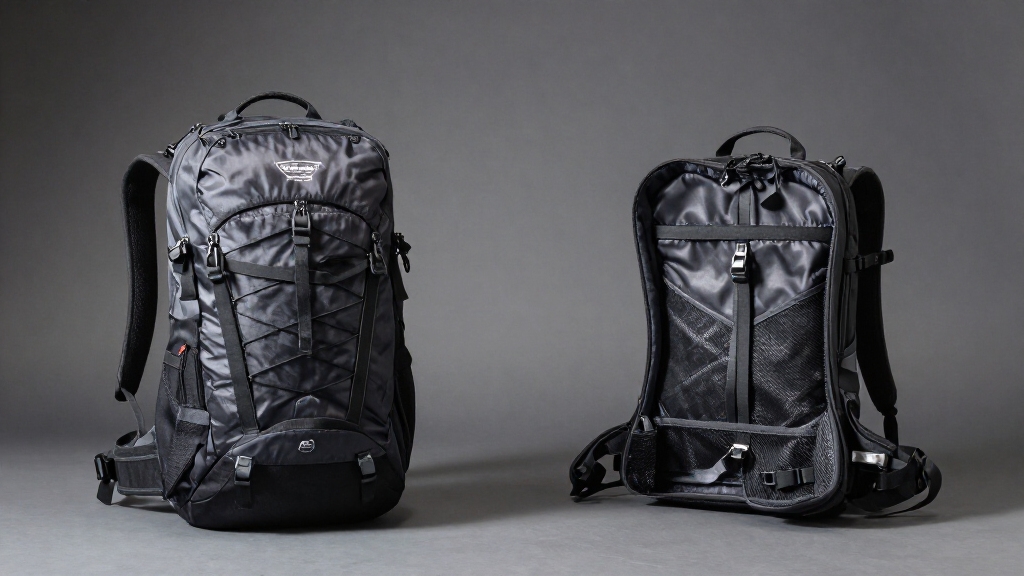
When comparing the Porter 46 and Farpoint 40 in terms of size and capacity, you’ll notice the Porter 46 offers a more generous 46 liters of packing space versus the Farpoint’s standard 40 liters.
The Porter 46 measures 56 x 36 x 28 cm, providing a slightly bulkier profile than the Farpoint 40’s 55 x 35 x 23 cm dimensions.
This difference translates into more room for your belongings in the Porter 46, making it ideal if you prioritize volume.
However, the Farpoint 40’s slimmer build makes it easier to fit into tighter spaces, especially when you need a compact option.
Ultimately, you’ll find the Porter 46 better for maximum packing, while the Farpoint 40 caters to those valuing a sleeker, more streamlined size.
Both backpacks feature streamlined profiles that help reduce snagging and improve ease of travel.
Weight and Carry-On Compatibility: Which Backpack Is Easier to Travel With?
You’ll often find the Farpoint 40 easier to manage in terms of weight and carry-on compatibility, weighing between 3.11 and 3.17 pounds depending on size. This makes it lighter than the Porter 46’s 3.4 pounds.
This weight difference, though modest, contributes to the Farpoint 40’s advantage when negotiating airports or crowded transit. Additionally, the Farpoint 40’s slimmer dimensions make it a more reliable carry-on option across various airlines, reducing the risk of gate-checking.
In contrast, the Porter 46’s slightly larger size and weight mean it fits carry-on requirements on some airlines but not all, requiring more careful planning.
Both packs prioritize lightweight design but vary in load capacity and intended use, which influences their travel convenience.
Comfort and Harness: Which Backpack Feels Better on Your Back?
You’ll notice that the Farpoint 40 has a padded, adjustable harness, which really makes a difference for long-term carrying. It’s designed with comfort in mind, so if you’re planning to wear your bag for extended periods, you’re likely to appreciate how it feels on your back.
Now, the Porter 46 takes a different approach with a simpler, less supportive system. This one’s great for shorter transfers where you don’t need that extra harness support. So, if you’re just moving around for a bit, the Porter could be a solid choice!
The Farpoint 40’s adjustable suspension system helps distribute weight evenly, reducing fatigue on longer treks.
Harness Design Differences
Feel the difference in harness design the moment you sling on either the Osprey Porter 46 or the Farpoint 40.
The Farpoint 40’s padded, adjustable shoulder harness offers a more supportive fit, designed specifically for backpack-style carry. It contours well to your shoulders, easing strain during longer walks.
In contrast, the Porter 46 features a simpler harness system with less padding and support, making it suitable mostly for short transfers like airport to car.
While the Porter’s harness is easier to deploy quickly, it lacks the comfort features found on the Farpoint.
If you plan on carrying your pack for extended periods, the Farpoint’s harness design clearly edges out the Porter, providing better stability and load distribution.
Your choice depends on how long and often you’ll wear the pack.
For comparison, backpacks like the Black Ember Citadel 25 also emphasize comfort with well-padded straps and ergonomic design for all-day wearability.
Long-Term Carry Comfort
Although both backpacks serve their purpose well, the Farpoint 40 clearly outperforms the Porter 46 in long-term carry comfort due to its padded, adjustable harness and better load distribution. When you’re on your feet for hours, the Farpoint’s ergonomic design reduces shoulder strain, making it easier to bear heavier loads.
In contrast, the Porter 46’s simpler harness lacks padding and adjustability, which can lead to discomfort over extended use. You’ll notice the Farpoint’s slimmer profile and lighter weight also contribute to less fatigue, especially during multi-stop journeys.
While the Porter 46 excels in packing space and organization, it suits short transfers better. If comfort over long walks matters most, the Farpoint 40 remains the superior choice for backpack-style carrying. The Farpoint’s design emphasizes adjustable torso length and padded hipbelt features that enhance stability and reduce fatigue during extended use.
Organizing Gear: Porter 46 vs Farpoint 40 Layout and Features
When it comes to organizing gear, the Porter 46 offers more advanced features and greater compartmentalization compared to the Farpoint 40. You’ll find multiple internal compartments, mesh pockets, and a dedicated laptop sleeve. This makes it easier to separate your items and access them quickly.
The Porter’s front-panel clamshell opening lets you pack like a suitcase, which is ideal if you use packing cubes. It allows for quick entry without unpacking everything.
In contrast, the Farpoint 40 features a simpler layout with fewer compartments and less organizational variety. It focuses on a clean, minimalist design that suits travelers who prefer straightforward packing without extra dividers.
While the Farpoint’s design supports easy loading, it doesn’t offer the same level of internal separation or quick-access features as the Porter 46. Osprey is known for smart storage with efficient layouts that enhance packing organization and accessibility.
Best Travel Scenarios for Porter 46 and Farpoint 40
Choosing between the Porter 46 and Farpoint 40 often comes down to matching their organizational styles with your travel habits.
Selecting the Porter 46 or Farpoint 40 depends largely on how their organization fits your travel needs.
If you prioritize packing volume and easy access to compartments, the Porter 46 suits shorter urban trips or airport-to-hotel transfers where extra space matters.
Its front-panel access and multiple organizers help keep gear sorted during quick stops.
On the other hand, if your travels involve multi-stop itineraries, hostel stays, or long walks, the Farpoint 40’s lighter weight and better harness comfort make it ideal.
It’s also more consistently carry-on compliant, easing passages through stricter airlines.
Ultimately, you’ll pick the Porter 46 for maximum space and organization or the Farpoint 40 when comfort and reliable carry-on fit are more important.
Additionally, bags like the Topo Travel Bag highlight the benefits of carry-on compliance combined with durable, organized design for versatile travel needs.
Key Trade-Offs: Capacity, Comfort, and Carry-On Compliance
While both the Osprey Porter 46 and Farpoint 40 cater to travelers, you’ll find key trade-offs in capacity, comfort, and carry-on compliance that influence which bag suits your needs better.
The Porter 46 offers 46 liters of space, giving you more packing room and better organization with front-panel access. However, it’s heavier and bulkier, and you might struggle to fit it as a carry-on on stricter airlines.
In contrast, the Farpoint 40 is slimmer, lighter, and more consistently accepted as carry-on luggage. This makes it better for longer carrying and crowded transit. Its padded harness supports comfort over extended periods, though it sacrifices some packing volume and organizational features.
Ultimately, your choice depends on whether you prioritize extra capacity or ease and comfort during travel. Consider also the carry volume trade-offs between different pack sizes to balance capacity and form factor for your specific needs.
Frequently Asked Questions
Are Both Backpacks Water-Resistant or Weatherproof?
Both backpacks offer water-resistant materials but aren’t fully weatherproof.
You’ll find durable nylon fabrics with DWR (durable water repellent) coatings on each, which help repel light rain and splashes.
However, if you face heavy rain or wet conditions, you’ll want an additional rain cover for reliable protection.
Neither bag has built-in waterproof zippers or sealed seams, so don’t rely on them alone for severe weather.
Can the Porter 46 and Farpoint 40 Be Expanded With Additional Compartments?
Neither the Porter 46 nor the Farpoint 40 offer built-in expandable compartments or modular attachments for adding extra storage. You can’t increase their capacity with zippers or external pouches designed by Osprey.
However, you can always use packing cubes or external accessory pouches inside or clipped on. This won’t change the main bag’s internal volume.
Do Either of These Backpacks Come With a Warranty?
Like a trusty shield, both backpacks come with Osprey’s All Mighty Guarantee, covering repairs for any damage or defects for life.
You can count on either the Porter 46 or Farpoint 40 to be backed by this no-questions-asked warranty.
If something breaks, Osprey fixes it or replaces it, ensuring your investment stays protected.
This guarantee makes either bag a smart choice if durability and peace of mind matter to you.
Are There Color Options Available for Both Models?
Yes, you’ll find color options for both models. The Porter 46 usually offers a limited palette, often in neutral tones like black or gray, focusing on practicality.
The Farpoint 40 provides a bit more variety, including darker shades plus some muted blues or greens, aiming for versatility. While neither has flashy or bright colors, the Farpoint’s selection tends to be slightly broader.
This allows you to pick something that better matches your style.
How Easy Is It to Clean and Maintain Each Backpack?
Cleaning either backpack isn’t rocket science, but you’ll find the Farpoint 40 easier to maintain due to its simpler design and fewer compartments.
You can wipe it down quickly without hunting through pockets. The Porter 46’s extra organization means more zippers and crevices to clean, requiring more time and care.
Both recommend spot cleaning with mild soap and air drying, but the Farpoint’s minimalist layout saves you effort in upkeep.
Choose the Best Backpack for Your Next Adventure
Choosing between the Osprey Porter 46 and Farpoint 40 feels like picking the ultimate travel sidekick.
The Porter offers more capacity without sacrificing comfort, but the Farpoint nails carry-on size for stricter airline rules.
If you’re after maximum organization and padding, Porter wins. For lightweight ease and compliance, Farpoint’s your go-to.
Either way, you’re getting a backpack that’s tougher than a mountain goat on a rocky cliff, ready to handle your adventures with ease.
- Wingjacket Protection – Flexible compression straps and padded sidewalls protect your gear and…
- Stowaway Harness & Hipbelt – Deploys quickly for backpack-style carry and tucks into a pocket in…
- Stable, Close-to-Body AirScape Backpanel – Comfortable ridge foam, vented backpanel moves with you…
- TRAVEL PACK: Perfect for your next globetrot, this crowd-favorite travel pack features focused…
- CARRY-ON READY: Skip the baggage claim—this bag meets most carry-on size requirements. Always…
- TRAVEL ORGANIZATION: A direct-zip 3-1-1 pocket, front pocket and water bottle pockets store…
Last update on 2026-11-10 / Affiliate links / Images from Amazon Product Advertising API