
How Do You Measure a Suitcase Size: Smooth-Sailing Adventure

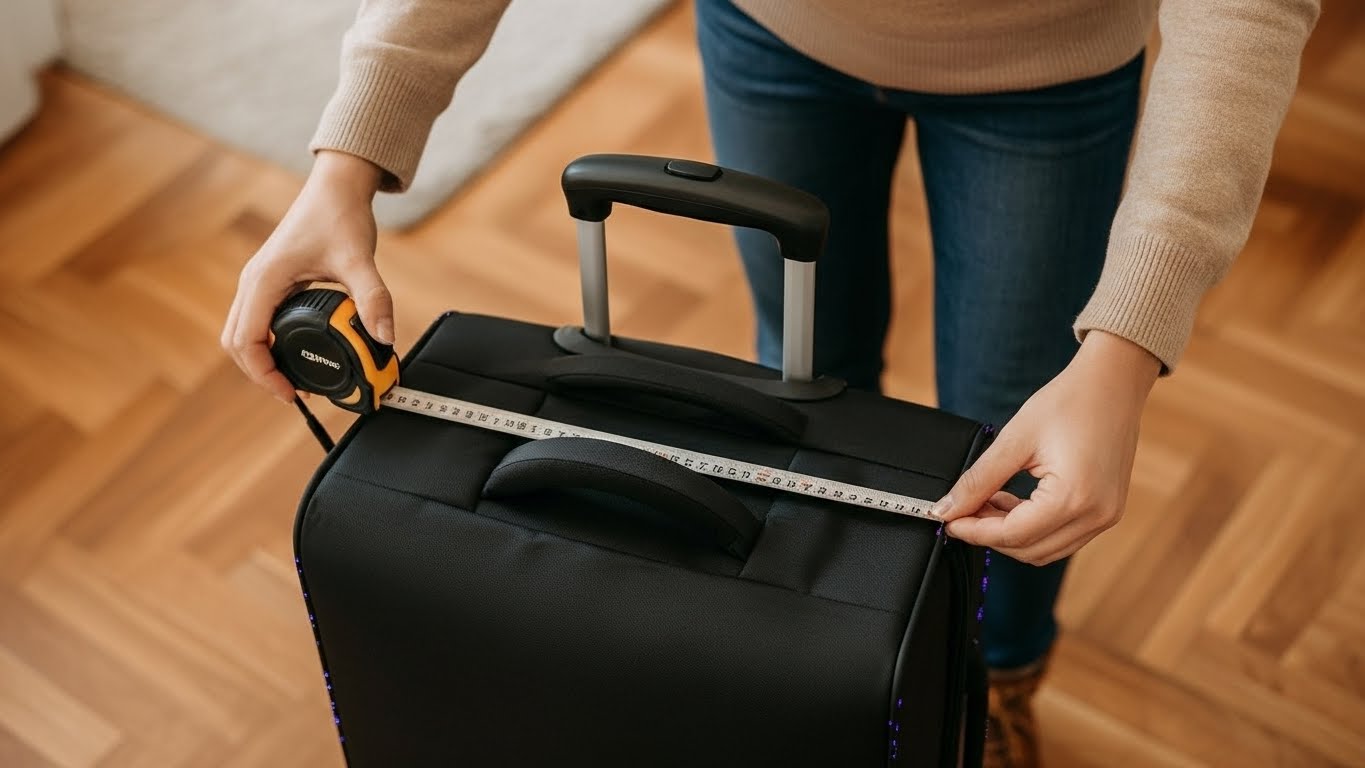
To measure your suitcase size accurately, use a flexible tape measure on a flat surface. Stand the suitcase upright and measure height from the bottom of the wheels to the top of handles, including any non-retractable ones.
Then, measure the width at the suitcase’s widest point, including side handles and protrusions. Lay it flat to measure depth, factoring in expandable sections fully zipped. Add these dimensions to check airline size limits and avoid fees.
Keep exploring to discover tips on matching sizes to travel needs.
Key Takeaways
- Measure suitcase height from the bottom of the wheels to the top, including all handles fully extended or retracted.
- Measure width across the suitcase’s widest point, including side handles and protrusions.
- Measure depth by laying the suitcase flat and measuring from back to front, including expandable sections and external pockets.
- Use a flexible measuring tape on a flat surface with the suitcase empty, fully closed, and standing naturally.
- Add height, width, and depth measurements to calculate total linear size for airline compliance and avoid oversized fees.
Importance of Accurate Suitcase Measurements
Because airlines enforce strict size and weight limits, measuring your suitcase accurately is essential to guarantee costly overweight fees and last-minute hassles.
Accurately measuring your suitcase helps avoid expensive overweight fees and last-minute travel headaches.
When you know your suitcase’s exact dimensions and weight, you can steer clear of surprise charges that sometimes reach hundreds of dollars per bag. This precision also lets you pack strategically, distributing weight evenly across bags to stay within limits.
Using a luggage scale at home before traveling helps verify your suitcase weight and avoid overweight surprises at the airport. It is equally important to measure your suitcase including wheels and handles to ensure the total dimensions comply with airline size restrictions.
You’ll save money by preventing repeated overweight fees and avoid stressful airport delays caused by repacking or rejected luggage. Accurate measurements help you select the right suitcase for your airline’s rules, whether for carry-on or checked baggage.
Tools Needed for Measuring Your Suitcase
To get accurate suitcase measurements, you’ll want to gather a few essential tools that make the process straightforward and reliable.
Start with a flexible measuring tape, perfect for capturing curves and irregular shapes, or a rigid tape for hard-shell luggage to keep lines straight. Measuring the height, width, and length separately can help you understand the dimensions accurately.
Choose one with both metric and imperial units to meet airline standards. Measure on a flat, stable surface like a table or floor to prevent deformation and guarantee consistent results. It’s best to measure your suitcase in its upright position to include all protruding parts such as handles and wheels, as these are crucial for external dimensions.
Keep a notebook or digital device handy to record your measurements immediately, avoiding mix-ups. Though optional, a luggage scale helps verify weight limits too.
If you lack a tape, household items like A4 paper or milk cartons can help approximate dimensions. These tools together guarantee you measure your suitcase precisely every time.
How to Measure the Height of a Suitcase?
When you’re measuring the height of your suitcase, begin at the very bottom—yep, that means the wheels should be resting flat on the floor.
It’s important to include any fixed handles in your measurement, but don’t forget to ensure that any extendable handles are fully pushed in. Always make sure your suitcase is empty and closed before measuring to get the most accurate exterior dimensions.
Measuring with the suitcase in its typical use state ensures precise results. Trust me, this little step can save you from unexpected surprises at check-in and makes sure your suitcase meets airline requirements.
Measure From Bottom
Measuring the height of your suitcase accurately starts with placing it upright on a flat, stable surface like a hardwood floor or table.
Make sure your suitcase is empty, fully closed, and standing naturally without leaning.
Next, retract any extendable handles fully unless they don’t retract completely; in that case, include them in your measurement.
Use a flexible tape measure and run it straight from the lowest point of the suitcase, including the bottom of the wheels, up to the highest fixed point. Keep the tape taut for precision.
Remember, airlines count protrusions like wheels and non-retractable handles in size limits, so including these guarantees your measurement matches airline requirements.
Avoid soft surfaces to prevent distortion, and double-check your measurement for accuracy.
Also, ensure the surface is flat and level to prevent skewed measurements.
For best results, always measure at the widest and tallest points to capture total linear inches accurately.
Include Wheels and Handles
Although it might seem straightforward, including wheels and handles in your suitcase height measurement is vital because airlines count these parts toward your bag’s total size.
Start by placing your suitcase upright on a flat surface, making certain it’s fully closed and empty. Measure from the very bottom of the wheels, the part touching the floor, to the top of the suitcase, including any handles.
This measurement procedure ensures you capture the entire bulk of the luggage accurately. Regularly inspecting and protecting the wheels with preventive measures helps maintain their condition during travel.
Retract telescopic handles fully; if they don’t retract, measure their full extended length. Fabric or fixed handles should remain in their normal position.
Use a flexible tape measure to navigate curves smoothly. Remember, omitting wheels or handles can result in underestimating your suitcase’s height and possibly extra fees.
Measuring the Width of Your Suitcase Correctly
When you’re measuring the width of your suitcase, don’t forget to factor in those side handles. They can actually add to the total size! Make sure to measure across the front of the suitcase from one edge to the other using a tape measure to get an accurate reading of the width measurement method.
So, take a moment to focus on the widest part of the suitcase. Sometimes, that could be different from the main body because of any bulges or protrusions.
Include Side Handles
Don’t overlook the side handles when you size up your suitcase’s width. They often stick out enough to make a difference in measurements. To get it right, lay your suitcase flat on a rigid surface and measure from one outermost edge of the side handle to the other.
If the handles collapse, measure them in the folded position since airlines usually expect that. For fixed side handles, include their full extension to avoid surprises at check-in. Use a flexible tape to contour around padded handles for accuracy, and take multiple measurements if needed.
Remember that accurate suitcase measurements should include all protrusions like handles and pockets to avoid exceeding airline size limits. It’s also important to verify your measurements against the airline size restrictions to ensure your suitcase qualifies as a carry-on.
Measure Widest Part
To measure the width of your suitcase accurately, start by placing it upright on a flat surface and identifying its widest point from side to side. Some suitcases taper at the top or bottom, so always measure horizontally across the broadest section to avoid underestimating.
Include wheels, external pockets, latches, built-in locks, and expandable sections, since airlines consider these in total dimensions.
Use a flexible measuring tape to contour the shape precisely, and make certain the suitcase is empty and closed for accuracy. Consider whether your suitcase has spinner wheels or inline wheels, as the wheel design can affect the overall width.
Mark the widest points visually before measuring. Remember, hard-shell suitcases usually have uniform width, while softside and tapered designs vary, so careful measurement is essential.
Getting this right helps avoid oversized fees and ensures your luggage fits airline requirements.
Always measure the suitcase width including wheels to ensure the full external dimension is captured as airlines require.
Determining the Depth of a Suitcase
Figuring out the depth of your suitcase means measuring from its back to the front, including every bump and bulge that could affect how it fits in overhead bins or checked luggage compartments.
Lay your suitcase flat on its back on a stable surface. Use a flexible tape measure to capture the full distance from the back panel to the front, including any external compartments, expandable zippers, and hard-shell protrusions. Consider that some airlines have specific size and weight limits for checked luggage, so accurate measurement is crucial.
Don’t forget to include wheels, bumpers, handles, and side pockets that add to the depth. If your suitcase has expandable features, measure it fully zipped and packed to get the maximum depth.
Always round up to the nearest inch to make certain you meet airline size requirements and avoid unexpected fees. It is also important to measure luggage after fully packed, paying attention to any expandable sections and bulges to ensure accurate dimensions post-packing measurement.
Calculating the Total Linear Dimensions
Now that you’ve measured the depth of your suitcase, it’s time to calculate its total linear dimensions, a key figure airlines use to determine if your luggage meets size requirements.
To do this, add together the height, width, and depth, making certain each measurement includes all protruding parts like wheels, handles, and external pockets.
Add height, width, and depth, including wheels, handles, and pockets for accurate suitcase measurements.
Position your suitcase upright on a flat surface, measure from the bottom of the wheels to the top, include side handles and locks in the width, and factor in any expandable sections for depth.
Using a suitcase with TSA-approved locks can provide added security during your travels. Use a flexible tape for accuracy and round up to the nearest half-inch.
This total linear dimension helps you avoid oversize fees and ensures your suitcase fits airline policies, typically capped around 62 inches for checked baggage. The linear inches measurement includes external features, so be sure to measure any accessories that stick out.
Comparing Measurements With Airline Size Limits
When comparing your suitcase measurements with airline size limits, it’s important to guarantee the specific allowances each carrier sets for carry-on and checked baggage.
Most U.S. airlines cap carry-ons at about 22 x 14 x 9 inches, including wheels and handles. However, Southwest allows slightly bigger bags at 24 x 16 x 10 inches.
Checked bags usually must stay within 62 linear inches (length + width + height) to avoid oversized fees. Remember, airlines measure your luggage including all external parts, so be precise.
Many enforce these limits strictly using sizing bins at gates. Additionally, weight limits often accompany size rules; checked bags are generally capped at 50 pounds.
Since carry-on size limits differ by airline, it’s always wise to check your specific carrier’s policy before packing. Understanding these details helps you avoid surprise fees and guarantee your suitcase fits airline requirements smoothly.
Tips for Choosing the Right Suitcase Size Based on Measurements
After you compare your suitcase dimensions with airline size limits, the next step is choosing the right suitcase size that fits both your travel needs and those restrictions.
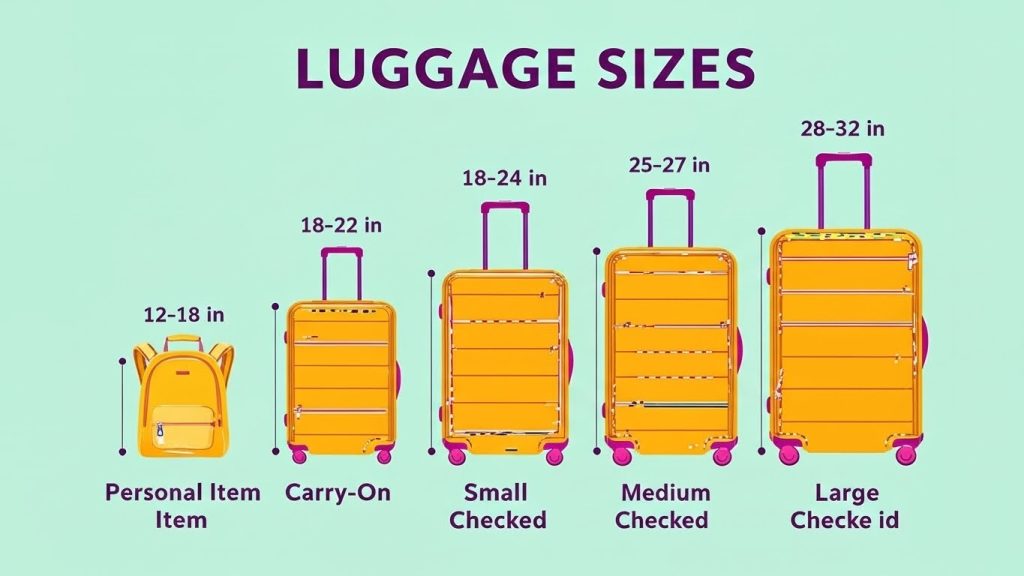
Start by matching suitcase height and volume to your trip length: small carry-ons for short trips, medium for week-long, and large for extended travel. For example, a medium suitcase around 67 cm tall is ideal for a week’s vacation.
Match suitcase size to trip length: small for short, medium for week-long, large for extended travel.
Remember to include wheels, handles, and any external parts in your measurements, as airlines count these.
Consider whether the suitcase is soft or hard shell; softshells may expand beyond measured depth when packed. Also, factor in your mode of transport’s storage space and weight limits.
By balancing capacity with portability and compliance, you’ll pick a suitcase size that’s both practical and efficient. This way, you can avoid the hassle of oversized or undersized luggage during your journey.
Frequently Asked Questions
How Do Soft-Sided Suitcases Affect Measurement Accuracy?
Soft-sided suitcases affect measurement accuracy because their flexible fabric can expand or compress depending on how much you pack.
This means the depth and overall size might change, making it tricky to get exact dimensions.
You’ll need to measure when the bag is empty and zipped, then again when fully packed or expanded, using a soft tape for flexibility.
Can Suitcase Weight Impact Size Restrictions?
Yes, suitcase weight can impact size restrictions because airlines balance both factors to guarantee safety and operational efficiency.
Even if your bag fits size limits, exceeding weight caps might lead to extra fees or refusal.
Heavy suitcases stress aircraft balance and ground handling, so airlines enforce weight limits alongside size.
You should weigh your bag carefully and check airline policies to avoid surprises at the gate and guarantee smooth travel.
Are Expandable Suitcase Sections Included in Measurements?
Absolutely, you’ve got to include expandable sections in your suitcase measurements!
Airlines treat that extra bulge like it’s the whole suitcase on steroids.
If you ignore it, you risk surprise fees or your bag being denied.
Always measure with the expandable part fully zipped open, wheels and handles included, so you know your max size.
This way, you’re never caught off guard and breeze through airport checks without drama.
How Often Should Suitcase Dimensions Be Rechecked?
You should recheck your suitcase dimensions before every flight, especially when switching airlines or traveling internationally.
Airline policies can change frequently, and your luggage might shift shape due to wear, packing, or expandable sections.
Measuring regularly helps you avoid unexpected fees and hassles at check-in.
If you buy new luggage or notice any damage, check dimensions immediately.
Staying proactive keeps your travel smooth and stress-free.
Do Airlines Measure Suitcases Differently at Check-In?
At check-in, airlines do measure your suitcase with varying precision, like different artists using unique brushes on the same canvas.
Some use manual tape measures, while others rely on automated machines or fixed-size slots.
They’ll include handles, wheels, and pockets, ensuring every nook counts.
So, you can’t expect uniformity everywhere; each airline’s approach shapes how strictly they enforce size limits.
This means your bag might pass smoothly in one airport but prompt a second glance in another.
Transform Your Trip With the Power of Proper Luggage Sizing
Now that you know how to measure your suitcase’s height, width, and depth accurately, you’re armed with the power to avoid airline headaches and packing disasters.
Remember, those total linear dimensions aren’t just numbers; they’re your ticket to stress-free travel. Choosing the right suitcase size based on precise measurements is like wielding a magic wand that transforms your journey into pure smooth sailing.
So, measure carefully and pack confidently every time!